
Key Takeaways:
- Pressure-sensitive adhesives (PSAs) enable cleaner, lighter, and more reliable product designs across multiple industries.
- Modern PSA technologies increasingly replace screws, clips, and welds in electronics, automotive, and medical devices.
- PSAs improve assembly efficiency, reduce part count, and support thinner, more compact designs.
- Advanced solutions, especially those from 3M, offer strong bonding, vibration damping, sealing, and electrical insulation.
- Real-world use cases show how PSAs support durability, compliance, and long-term performance.
- Working with an experienced converter ensures PSA materials are applied precisely and perform as intended.
Why Pressure-Sensitive Adhesives Matter in Modern Design
As products become thinner, lighter, and more complex, traditional mechanical fasteners often become a limiting factor. Screws, rivets, and clips add weight, require extra components, and introduce stress points that can compromise performance over time.
Pressure-sensitive adhesives solve many of these challenges. By bonding with light pressure and no curing time, PSAs allow engineers to attach, seal, cushion, or insulate components without redesigning entire assemblies. The result is greater design freedom, improved aesthetics, and more efficient manufacturing.
How PSAs Are Replacing Mechanical Fasteners
Modern PSA technologies do far more than “stick parts together.” In many applications, they outperform mechanical fasteners by delivering multiple functions at once.
Key advantages include:
- Uniform stress distribution, reducing cracking and fatigue
- Vibration damping without additional hardware
- Sealing against dust, moisture, and chemicals
- Electrical insulation or EMI/RFI shielding
- Cleaner assembly with fewer parts and tools
These benefits make PSAs especially attractive in industries where space, weight, and reliability are critical.
Electronics: Enabling Thinner, Smarter Devices
In consumer and industrial electronics, internal real estate is at a premium. PSAs are widely used to bond displays, secure batteries, mount sensors, and manage thermal or electromagnetic performance.
Real-World Use Case
A handheld electronic device replaces screws and brackets with a high-performance PSA tape to secure internal components. This change:
- Reduces assembly time.
- Allows a slimmer enclosure.
- Improves resistance to vibration and shock.
- Simplifies future design updates.
PSAs also eliminate the risk of cracked housings caused by overtightened fasteners, which is an increasingly common concern in compact devices.
Automotive: Lightweight Bonding Without Compromise
Automotive designers face constant pressure to reduce weight while maintaining durability and safety. PSAs play a growing role in interior and exterior assemblies, wire management, gasketing, and trim attachment.
Real-World Use Case
An automotive supplier replaces metal clips with structural PSA tape to mount interior panels. The result:
- Lower overall vehicle weight.
- Reduced rattles and noise.
- Faster assembly on the production line.
- Improved long-term durability under vibration and temperature cycling.
Advanced PSA systems are engineered to withstand heat, cold, UV exposure, and chemicals, making them well-suited for demanding automotive environments.
Medical Devices: Precision, Cleanliness, and Compliance
Medical device design places unique demands on materials. Adhesives must be consistent, clean, and often biocompatible—while supporting tight tolerances and regulatory requirements.
Real-World Use Case
A disposable diagnostic device uses PSA films and tapes to bond layered components. This approach:
- Eliminates mechanical fasteners that could trap contaminants.
- Supports single-use, cost-effective production.
- Enables precise alignment during automated assembly.
- Maintains reliable bonding throughout the device’s shelf life.
In medical applications, PSAs help balance performance, manufacturability, and patient safety.
Why 3M™ Pressure-Sensitive Adhesives Lead the Way
Not all PSAs are created equal. 3M™ Pressure Sensitive Tape has invested decades into developing adhesive technologies customized for engineering-driven applications.
Key characteristics designers rely on include:
- Consistent bonding across varied substrates.
- Long-term performance under stress and environmental exposure.
- Specialized options for thermal management, EMI shielding, and cushioning.
- Proven performance in regulated and high-reliability industries.
Choosing the right PSA formulation is just as important as selecting the right mechanical component.
The Importance of Precision Conversion
Even the best adhesive material can fail if it’s applied incorrectly. Precision die cutting, laser cutting, and material handling ensure PSAs perform exactly as designed.
Tight tolerances, clean edges, and repeatable part quality are essential, especially in high-volume production where small inconsistencies can cause major downstream issues.
How Thrust Industries Supports PSA-Driven Design
Toward the end of the design process, execution matters. Thrust Industries works with engineers and procurement teams to convert advanced PSA materials, including 3M™ pressure-sensitive adhesives into precision-cut components ready for production.
With ISO-certified processes, rapid prototyping, and deep material expertise, Thrust helps teams:
- Validate adhesive selection early.
- Reduce assembly complexity.
- Scale from prototype to full production with confidence.
Thrust Is Your Source for Pressure-Sensitive Adhesive Solutions
Pressure-sensitive adhesives are no longer a secondary design choice. They are a core enabler of modern product innovation. When applied correctly, PSAs simplify assemblies, improve performance, and open new possibilities across electronics, automotive, and medical applications.
If you’re evaluating how pressure-sensitive adhesives can replace mechanical fasteners or improve your next design, contact Thrust Industries to discuss material options, prototyping, or precision conversion support. You can also request a free quote to see how PSA-based solutions can streamline your production process.
 Cost & Performance Tradeoffs When Switching from Mechanical Fasteners to Die Cut Tapes
  How to Get the Most from Your 3M™ VHB™ Tape
  Die Cut 3M™ Foil Tapes Provide Advantages for EMI/RFI Management
 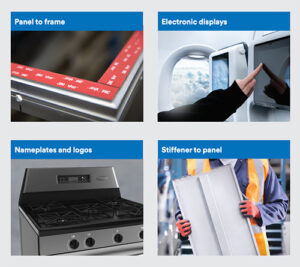 4 Industry Applications for 3M™ VHB™ Tape
  5 Innovative Projects that Utilize 3M™ Dual Lock™ Tape