
Key Takeaways:
- Custom die cutting makes it possible to produce uniquely shaped components that standard cutting methods or off-the-shelf parts cannot accommodate.
- Complex geometries, including irregular contours, internal cutouts, narrow features, and intricate openings, can be manufactured with precision and repeatability.
- A wide range of flexible materials, including foams, films, rubber, adhesives, and specialty laminates, can be converted into custom components.
- Material properties, dimensional tolerances, and part geometry determine which cutting process will deliver the best results.
- Prototyping and design-for-manufacturability reviews help identify potential production challenges before full-scale manufacturing.
- Working with an experienced custom die cutting partner can simplify sourcing, reduce material waste, and support consistent production quality.
When Standard Shapes Aren’t Enough
Not every manufactured component fits a standard size or configuration. As product designs become more specialized, engineers and product developers frequently need components with unusual geometries, intricate cutouts, or precise dimensions that cannot be sourced from existing inventory.
- a gasket may need to fit around multiple mounting points
- an adhesive component might require an irregular shape to bond two surfaces without interfering with nearby features
- a protective foam insert may need to accommodate several components within a compact enclosure
These are situations where custom die cutting for complex, non-standard shapes becomes particularly valuable.
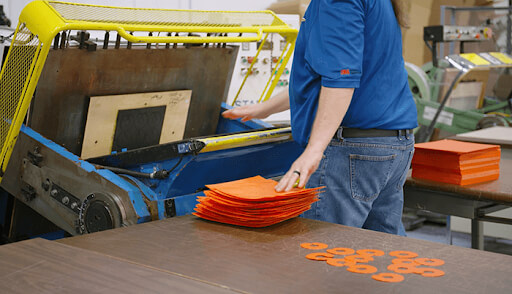
Custom die cutting uses specialized tooling to cut materials into specified shapes and dimensions. Unlike conventional cutting methods that may require multiple operations, die cutting can produce detailed components with consistent geometry in a repeatable manufacturing process.
The result is a component designed around the product’s requirements rather than a product design compromised to accommodate a standard component.
What Complex Shapes Can Custom Die Cutting Produce?
Modern die cutting processes can accommodate a broad range of geometries. The feasibility of a particular design depends on the material, thickness, tooling, required tolerances, and production volume.
Here are five examples of complex shapes commonly suited to custom converting applications.
1. Irregularly Shaped Gaskets and Seals
Gaskets rarely need to be simple circles or rectangles. Many industrial assemblies require seals that follow complicated housing contours, incorporate mounting holes, or accommodate multiple openings.
Custom die cutting can produce:
- Asymmetrical gasket profiles
- Multiple internal openings and mounting holes
- Narrow sealing surfaces and curved edges
- Complex perimeter shapes for equipment housings
For example, a die cut foam gasket for an electronic enclosure might require several openings for connectors and fasteners while maintaining a continuous sealing surface around sensitive components.
The challenge is not simply producing the shape. The material must also maintain its sealing properties after cutting and installation.
2. Intricate Adhesive Components
Pressure-sensitive adhesive materials are frequently converted into non-standard shapes for bonding, assembly, and mounting applications.
Custom die cut adhesive components may include:
- Thin adhesive frames for displays or electronic assemblies
- Irregular bonding patterns for automotive components
- Adhesive strips with positioning tabs
- Multiple openings to avoid sensors, fasteners, or ventilation areas
Perhaps a manufacturer assembling a compact electronic device needs a double-sided adhesive frame that bonds a display while leaving openings for internal components. Die cutting can create the required geometry while retaining a release liner to simplify handling and installation.
3. Custom Foam Pads and Protective Components
Foam materials are widely used for cushioning, vibration isolation, spacing, and environmental protection. Custom die cutting allows these materials to match unusual surfaces or fit into limited spaces.
Examples include:
- Contoured foam pads for automotive assemblies
- Vibration-dampening components with irregular profiles
- Protective foam shapes for appliance housings
- Custom spacers with precise openings and alignment features
Consider an appliance manufacturer that needs a foam pad to prevent vibration between two irregularly shaped components. A standard rectangular pad might interfere with mounting points or fail to provide sufficient coverage. A custom die cut component can be designed to match the available contact area, helping improve fit and assembly consistency.
4. Thin Films and Electrical Insulation Components
Thin films and specialty insulating materials often require intricate shapes to protect electrical components or separate conductive surfaces.
Potential applications include:
- Die cut insulating barriers for electrical assemblies
- Thin-film components with multiple cutouts
- Protective films with complex exterior contours
- Specialty components for electronic and energy equipment
These applications can present unique challenges because thin materials may stretch, wrinkle, or shift during converting.
Proper material handling, tooling selection, and process control are essential for maintaining dimensional consistency.
5. Multi-Layer Laminated Components
Some applications require more than one material to deliver the necessary performance.
A component might combine a foam layer for cushioning, an adhesive layer for attachment, and a protective film for surface durability. Custom lamination and die cutting can be used together to produce a finished component with a complex shape and multiple functional properties.
Examples include:
- Adhesive-backed foam gaskets
- Multi-layer cushioning and bonding components
- Protective films with integrated adhesive
- Laminated components requiring precise registration between layers
Producing these components as a single converted part can also simplify downstream assembly by reducing the number of individual materials that must be handled.
What Determines Whether a Complex Shape Can Be Die Cut?
Although custom die cutting offers considerable design flexibility, not every geometry is equally practical. Several factors influence whether a part can be manufactured successfully.
Material properties: Flexible foams, rubber, films, and adhesive materials respond differently to cutting pressure. Some materials compress, stretch, or deform, which can affect the finished dimensions.
Feature size and spacing: Very narrow sections, small holes, and closely spaced openings can increase tooling complexity and create challenges during material removal.
Dimensional tolerances: Tight tolerances may be achievable, but they must be evaluated in relation to material behavior, tooling, and the selected cutting process.
Material thickness: Thicker or highly compressible materials may require different tooling or cutting techniques than thin films and adhesive tapes.
Production volume: A process suitable for a prototype or short production run may not be the most economical option for thousands or millions of identical components.
The most effective approach is to evaluate these considerations early, ideally before the final component design is approved.
Custom Die Cutting vs. Laser Cutting for Intricate Shapes
One important question is whether a particularly complex shape should be die cut or produced using another cutting method. Both die cutting and laser cutting can manufacture custom geometries, but they offer different advantages.
| Consideration | Custom Die Cutting | Laser Cutting |
|---|---|---|
| Complex contours | Excellent for repeatable, tool-compatible geometries | Excellent for intricate or frequently changing geometries |
| Tooling | Requires custom tooling | Generally does not require a physical cutting die |
| Prototyping | May require tooling development | Often well suited to rapid design changes |
| High-volume production | Often highly efficient | May have longer processing times per part |
| Material limitations | Depends on compression and cutting characteristics | Depends on laser compatibility and heat sensitivity |
| Repeatability | Strong for established production runs | Strong with appropriate process controls |
For a uniquely shaped component expected to enter high-volume production, custom die cutting may provide a more economical long-term solution.
For highly intricate designs, low-volume projects, or components still undergoing revisions, laser cutting may offer greater flexibility.
In some cases, a manufacturer may use laser cutting during development before transitioning to die cutting for production.
Designing Non-Standard Components for Manufacturability
One of the most effective ways to control costs and improve quality is to involve a converting specialist before a design is finalized. A design-for-manufacturability review can identify opportunities to simplify production without compromising component performance.
Useful information to provide includes:
- A CAD drawing or dimensional specification
- Material type, thickness, and performance requirements
- Critical tolerances and functional features
- Adhesive or liner requirements, if applicable
- Expected annual production quantities
- Prototype and production deadlines
For example, a small adjustment to the spacing between two openings might improve tooling durability or reduce material waste without affecting how the component functions. Likewise, selecting an alternative material thickness or adhesive construction may make a complex shape easier to manufacture consistently.
These decisions can have a significant impact on production efficiency, particularly when the component will be manufactured in large quantities.
From Unique Component Designs to Repeatable Production
A successful custom die cutting project requires more than the ability to cut an unusual shape. The manufacturing process must consistently reproduce the approved design while meeting material specifications, dimensional requirements, and delivery expectations.
This becomes particularly important when a uniquely shaped component is part of a new product launch. A part that performs well during initial testing must also be practical to manufacture repeatedly as production volumes increase.
Experienced converting partners can help evaluate tooling options, material selection, prototype requirements, and production methods before significant investments are made. The objective is to establish a reliable process that supports both component performance and long-term manufacturing efficiency.
Custom Die Cutting Solutions from Thrust Industries
Thrust Industries works with manufacturers that need precision-converted components designed for specialized applications. Our capabilities include custom die cutting, laser cutting, adhesive converting, and custom lamination, allowing us to evaluate different manufacturing approaches based on each project’s requirements.
We work with a variety of materials, including foams, films, rubber, and pressure-sensitive adhesives, to develop components that meet specific functional and dimensional needs.
Whether your project involves an irregularly shaped gasket, an intricate adhesive component, or a multi-layer assembly, our team can help evaluate material options, production feasibility, and the most appropriate converting process.
We also understand the importance of moving efficiently from prototype development to repeatable production while maintaining consistent quality.
Have a Uniquely Shaped Component? Let’s Discuss What’s Possible.
A complex geometry should not automatically require a complicated manufacturing process. With the right material, tooling, and converting expertise, many non-standard components can be produced efficiently and consistently.
If you’re developing a new product or struggling to source a uniquely shaped component, Thrust Industries can help you explore your options. Contact us to discuss your component requirements, share your specifications, or request a quote for your next custom die cutting project.
 5 Red Flags That Mean It’s Time to Switch Die Cut Suppliers
 Die Cutting, Laser Cutting, or Waterjet: Which Process Is Right for Your Component?
 How to Write a Die Cut Specification That Prevents Rework and Rejected Parts
 How Advanced Foams and Films Are Changing Electronics Enclosures