
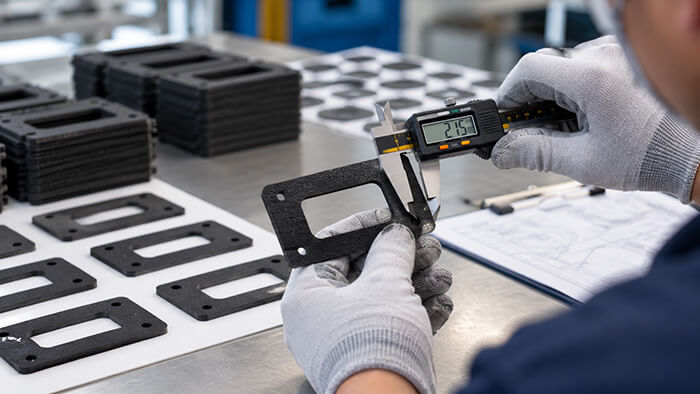
 When sourcing custom die cut components, precision parts, or adhesive-backed materials, quality is more than a line item on a supplier evaluation form. It directly affects production efficiency, product performance, and your ability to meet customer expectations.
One qualification that frequently appears in supplier requirements is ISO 9001:2015 certification. But what does that certification actually tell you about a manufacturer? More importantly, how does it translate into better parts, fewer production problems, and greater confidence in your supply chain?
Understanding what ISO 9001:2015 means in practical manufacturing terms can help you make more informed sourcing decisions.
Key Takeaways:
- ISO 9001:2015 is an internationally recognized quality management standard that establishes requirements for consistent processes, documented controls, and continuous improvement.
- Certification focuses on how a manufacturer manages quality, not simply whether individual parts pass inspection.
- Consistent processes help reduce defects and variation, particularly for custom die cut components produced in repeat orders or high volumes.
- Traceability and corrective action processes improve accountability when material, dimensional, or production issues arise.
- ISO certification supports supplier qualification, but buyers should also evaluate technical capabilities, communication, lead times, and material expertise.
- Working with an ISO 9001:2015 certified manufacturer can reduce sourcing risk by providing greater confidence in the systems used to manage quality.
What Is ISO 9001:2015 Certification?
ISO 9001:2015 is an international standard that defines the requirements for a Quality Management System (QMS). Developed by the International Organization for Standardization (ISO), it provides a framework for organizations to establish, monitor, and continually improve their quality processes.
Rather than prescribing exactly how a manufacturer must produce a component, ISO 9001:2015 focuses on the systems used to ensure that products and services consistently meet customer and applicable regulatory requirements.
These systems address several critical areas:
- Documented processes and quality procedures
- Defined responsibilities and accountability
- Risk identification and preventive planning
- Monitoring and measurement of performance
- Control of non-conforming products
- Corrective actions and continuous improvement
- Customer satisfaction and feedback
Certification means an independent certification body has audited the organization’s quality management system and determined that it meets the standard’s requirements within its defined scope.
ISO 9001:2015 certification does not guarantee that every part will be defect-free. Rather, it demonstrates that a manufacturer has established a structured system for managing quality, identifying problems, and improving performance.
How ISO 9001:2015 Affects the Parts You Receive
For buyers sourcing custom manufactured components, the value of ISO certification becomes clearer when examining its influence on everyday production.
More Consistent Part Quality
Consistency is essential when components must fit precisely into larger assemblies or perform reliably across thousands of finished products. In custom die cutting, even small variations in dimensions, material thickness, or adhesive placement can create assembly problems.
An ISO 9001:2015 quality management system supports consistency through defined production processes, controlled documentation, and appropriate inspection and verification procedures. The objective is to reduce unnecessary variation so that the components received in subsequent production runs meet the same established requirements as the approved parts.
Better Control of Materials and Specifications
Custom components often involve specialized materials such as foams, films, adhesives, insulation, and protective materials. These materials may have specific performance requirements involving thickness, compression, adhesion, temperature resistance, or durability.
ISO 9001:2015 requires manufacturers to establish controls appropriate to purchased materials, production processes, and customer specifications.
For buyers, these controls can help reduce the likelihood of problems such as:
- Incorrect materials entering production
- Outdated drawings or specifications being used
- Unapproved changes affecting component performance
- Inconsistent manufacturing or inspection practices
This becomes particularly important when a seemingly minor material substitution could affect the performance of an entire finished product.
Stronger Traceability and Accountability
When a quality issue occurs, identifying the cause quickly can make the difference between a manageable correction and a costly production interruption. ISO 9001:2015 includes requirements for identification and traceability where appropriate, as well as the control of non-conforming outputs.
Depending on the manufacturer’s processes and customer requirements, this may include records related to materials, production lots, inspection results, and corrective actions. For buyers, effective traceability makes it easier to investigate problems, determine which components may be affected, and coordinate corrective measures.
A Structured Approach to Correcting Problems
Even capable manufacturers occasionally encounter production challenges. What separates dependable suppliers is how effectively they respond.
ISO 9001:2015 requires organizations to address non-conformities and take appropriate corrective action. This means identifying what went wrong, evaluating the cause, implementing necessary changes, and reviewing whether those changes were effective.
For example, if a die cut component repeatedly falls outside dimensional tolerances, a structured corrective action process encourages the manufacturer to investigate the underlying cause rather than simply replacing the rejected parts.
The result can be fewer recurring issues and a more dependable supplier relationship.
Why ISO 9001:2015 Matters for Custom Die Cutting
Custom die cutting presents quality challenges that make consistent process control especially valuable. Unlike standard off-the-shelf products, custom die cut components are manufactured to meet application-specific requirements. A part may need to maintain tight dimensional tolerances, accommodate unusual shapes, or combine multiple materials in a precise configuration.
Potential problems include:
- Dimensional inconsistencies that interfere with assembly
- Adhesive placement errors that affect bonding performance
- Material variation that changes fit or function
- Excessive scrap caused by inconsistent cutting
- Production delays resulting from rejected components
A well-implemented quality management system helps manufacturers control these risks through repeatable processes, defined acceptance criteria, and ongoing performance evaluation. This is especially important when moving from initial prototypes to full-scale production.
Buyers need confidence that the approved component can be reproduced consistently as order volumes increase.
Does ISO 9001:2015 Certification Guarantee On-Time Delivery?
Not necessarily. ISO 9001:2015 requires organizations to plan and control their operations, evaluate performance, and address risks that could affect their ability to meet customer requirements. These practices can contribute to more reliable production and delivery performance.
However, certification alone does not establish a manufacturer’s capacity, guarantee a particular lead time, or eliminate supply chain disruptions.
Buyers should still evaluate a supplier’s production capabilities, responsiveness, scheduling practices, and history of meeting delivery commitments.
The strongest supplier relationships combine a documented quality system with the technical expertise and operational flexibility needed to meet real-world production demands.
What Buyers Should Ask an ISO 9001:2015 Certified Supplier
Certification is an important starting point, but it should not be the only qualification used when selecting a manufacturing partner.
Before approving a supplier, consider asking:
- Is your ISO 9001:2015 certification current, and does its scope cover the manufacturing services we need?
- How do you verify that custom parts meet our dimensional and material specifications?
- What inspection or quality documentation can you provide?
- How do you manage engineering revisions and material changes?
- What happens if a shipment contains non-conforming components?
- Can you maintain consistent quality as production volumes increase?
- How do you communicate potential production or delivery problems?
The answers can reveal how effectively a manufacturer applies its quality management system in practice.
ISO 9001:2015 Certified Quality at Thrust Industries
Quality management is an established part of how Thrust Industries operates. Our Quality Management System is certified to ISO 9001:2015 by NSF International Strategic Registrations (NSF-ISR), an independent certification body.
Our ISO 9001:2015 certification covers the sale and distribution of plastics and adhesives, as well as the conversion of adhesive tapes, foams, paper, plastics, rubber, thin-gauge metals, and other materials.
This certification demonstrates that our quality management processes have been independently assessed against internationally recognized requirements for process control, accountability, and continuous improvement.
For customers sourcing custom components, these principles are particularly important when applications require consistent material properties, precise dimensions, and repeatable manufacturing processes.
Our capabilities include:
- Custom Die Cutting: Precision conversion of materials into application-specific shapes and components.
- Laser Cutting: Flexible cutting solutions for specialized components and prototype applications.
- Adhesive Converting: Custom conversion of adhesive tapes and adhesive-backed materials, including 3M™ products.
- Material Expertise: Assistance selecting foams, films, plastics, rubber, adhesives, and other materials for specific applications.
- Prototyping and Production: Support for developing custom components and transitioning approved designs into production.
Our certification provides customers with independent confirmation that we maintain a quality management system designed to support consistent processes and ongoing improvement.
ISO 9001:2015 Certification Details
- Certified Organization: BMG Incorporated DBA Thrust Industries
- Certification Body: NSF-ISR
- Certificate Number: C0097729-IS7
- Certificate Expiration: August 15, 2027
For procurement teams that require documented supplier qualifications, our certification provides an additional level of confidence when evaluating Thrust Industries as a manufacturing partner.
Choose a Supplier That Makes Quality a Priority
ISO 9001:2015 certification is more than a credential to check off during supplier qualification. It provides meaningful insight into how a manufacturer approaches process control, accountability, and continuous improvement.
For custom manufactured components, those practices can translate into greater consistency, fewer avoidable problems, and more confidence in your supply chain.
If you’re evaluating suppliers for custom die cutting, laser cutting, or adhesive converting, contact Thrust Industries. Our team can discuss your application, material requirements, and production goals to help you identify a dependable solution.
 A Year of Progress, Precision, and Performance at Thrust Industries
 What Makes a Great Laser Cutting Machine?
 Thrust Invests in Preco Jumbo Roll Laser Processing Machine
 Thrust Industries Announces Updated and Redesigned Website